


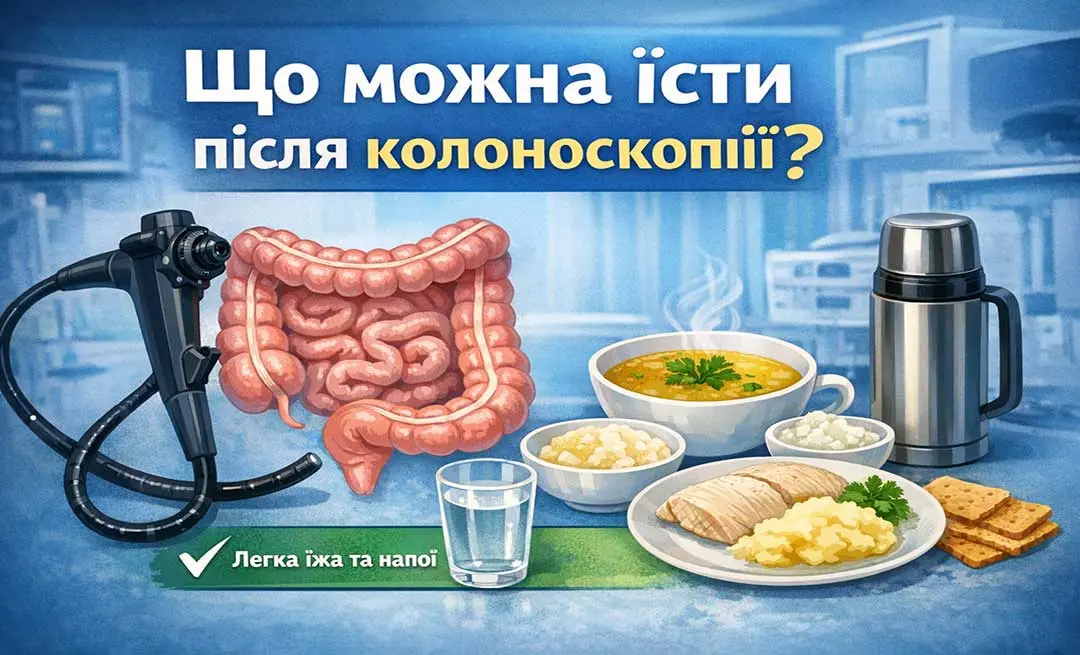
It is worth asking yourself this question before the colonoscopy! To take, for example, warm broth or tea in a thermos with you and be ready.
And although there is no such diet or strict recommendations on this matter, my more than 20 years of practical medical experience, mostly in surgery and endoscopy, allows me to give a clearer answer to this question.
Let's go step by step:
When can you start drinking or eating after a colonoscopy
Let's start with the fact that a colonoscopy can be performed both under sedation or short-term sleep, and without. And this already requires attention. For example, after a colonoscopy under sedation, the patient will rest for a certain time, so this question is somewhat postponed in time, at least for half an hour, until the patient wakes up. But it is possible immediately, if the patient is able.
When a colonoscopy was performed on the same day as a gastroscopy, you can start drinking only after the swallowing reflex has been restored, which can take up to an hour after the examination. This is because local anesthesia is often used for gastroscopy, which “freezes” the ability to swallow. Again, it is individual and in some patients the swallowing reflex works immediately and you can drink and eat or not immediately. I always play it safe and remind the patient: first try to take a small sip and, if everything goes well, you can drink and eat immediately after the restoration of swallowing.
What should you start drinking or eating after a colonoscopy?
With ordinary drinking water in any case. And with a small sip of water - to check the ability to swallow. If everything has been restored, you can continue to drink and eat. There is one more nuance after a gastroscopy. If there was a biopsy, it is better to take chilled water and regular ice cream for the first appointment (if there are no prohibitions). If only a colonoscopy was performed, then it is possible and better to take warm sweet tea or light broth, which will help restore the water-electrolyte balance as quickly as possible and simply come to your senses.
The first drink or meal after a colonoscopy should be small
It is advisable to gradually resume eating and drinking according to the specified dietary recommendations for the next 3 days with a gradual return to the usual diet and diet. What is a special diet as one of the stages before a colonoscopy? These are those foods, dishes, and meal regimens that allow you to minimize the load on the intestines.
It is advisable to change the usual three-time meal to 5-6-time meals. I tell my patients how to simplify this task: in fact, we definitely leave the main 3 meals: namely, breakfast, lunch and dinner, but we divide each of them into 2 parts. How? Let's simplify the task as much as possible for a busy person: for example, we divide lunch into main meals and in 1-2 hours you can drink compote, tea or another drink. This reduces the load on the gastrointestinal tract and facilitates digestion. It helps to achieve the goal simply and effectively!
Diet after colonoscopy
There is no such diet after colonoscopy, but at least the first three days after the study involves easily digestible refined food that contains almost no indigestible substances. I will note the mandatory consideration of your personal needs if you have a special permanent diet, for example, with diabetes, phenylketonuria and other diseases.
That is, it is advisable to apply all the dietary recommendations that you used to prepare for the study in the first days after it.
Partial restrictions on drinks and food after colonoscopy:
Solid food, black and white bread; all grain products (whole grain pasta, products containing crushed grains, nuts, poppy seeds, sesame seeds, coconut flakes, etc.); yogurt containing fillers (pieces of fruit and berries, muesli); pudding (with additives); sour cream, colostrum, fatty cottage cheese, cabbage soup and borscht, milk soups, cream soups, okroshka; fatty meats, duck, goose, smoked meats, sausages, sausages; fatty fish (dishes made from herring, mackerel, trout, salmon); all fresh vegetables; cabbage in any form; all types of greens; all fruits, berries, dried fruits (raisins, prunes, dried apricots); alcoholic beverages, kvass, carbonated water, dried fruit drinks with fruit pulp; spicy seasonings (horseradish, pepper, mustard, onion, vinegar, garlic), seasonings with grains, herbs; pickles, canned food, salty and pickled dishes, especially mushrooms; seaweed…
You can eat after a colonoscopy:
Oh… And what can you eat then? Correctly allow yourself:
- Crackers (without additives, sesame and poppy seeds).
- Low-fat cottage cheese, cheeses, natural yogurt (without additives), no more than 2 glasses of skim milk.
- Soups on low-fat broth.
- Well-cooked dishes from low-fat beef, veal, chicken, turkey, rabbit in boiled form, also in the form of steam cutlets, meatballs.
- Low-fat fish (dishes made from cod, pike perch, perch, pike…)
- Food can be boiled, baked in the oven, microwave, pressure cooker and steamer.
- Tea, weak coffee, compotes, jelly, juices (clear, without pulp, from dried fruits, berries, grains).
- Sugar, honey, jelly, syrup.
After a colonoscopy under sedation or light anesthesia, it is better to coordinate coffee and cigarette smoking with your doctor, because there may be nuances depending on the situation!
Coffee after a colonoscopy
There is no strict ban on coffee. But considering that the colonoscopy itself, as well as sedation, are quite stressful factors for the cardiovascular system, and coffee only plays the role of an additional load, it is better to postpone the first cup of coffee.
Indeed, after a cup of coffee, there is a feeling of restoration of strength for 15-20 minutes, and then the state returns to the previous one. This is explained by the pharmacological properties of coffee.
Given the stimulating effect of coffee on intestinal peristalsis, I recommend that my patients wait a little with coffee, because the increased peristalsis of an already tired colon, i.e. preparation for the procedure, and the colonoscopy itself, coffee will also add to the load on it.
Smoking after colonoscopy
You can discuss smoking for a long time and philosophically prohibit it, of course I can, but heavy smokers will not listen to me at all. But a few words are worth saying. If polyps were removed during a colonoscopy, this can be equated to a mini-operation and the name is accordingly - polypectomy, the places of their removal require healing, and smoking can affect this process, so for at least a week it is worth limiting at least the number of cigarettes smoked per day!. Regarding the increased risk of bleeding after polypectomy: indeed, Nicotine narrows the blood vessels, affects their tone, but can also prevent the healing of small contact irritations.
If the procedure was performed under sedation (drug sleep), smoking can increase dizziness and discomfort. Therefore, after a colonoscopy, it is still worth at least getting home and then reaching for a cigarette, but it is better to postpone it for a while.
After a colonoscopy, gas may remain in the intestinal cavity, which was used to inflate it for a reliable examination of the mucosa, and bloating and gas formation are possible, which smoking can increase. I will not repeat myself: decide for yourself)
Alcohol after a colonoscopy
I will repeat quite rhetorically that alcohol is harmful to health.
And I must emphasize: do not drink alcohol in the first 2-3 days after a colonoscopy with or without sedation, because alcohol has the opposite effect on the psychotropic effect of propofol with dormicum. And it is very difficult to predict the result of such an interaction. Therefore, take care of yourself! And it is better to give yourself and your body the opportunity to just get enough sleep and rest. Alcohol enhances the depressing effect of drugs during sedation on the central nervous system, which can lead to respiratory arrest, a drop in blood pressure and death. After sedation, it is forbidden to drink alcohol for 24 hours after sedation, and it is better to wait a few days. In people who often drink alcohol, propofol can cause “paradoxical excitement” instead of sedation. How do we see this? It looks like the patient is sleeping, but at this time he seems to be dancing, lying on the table. Of course, under such circumstances, the dosage of drugs is changed and the procedure time is extended until the patient is so-called calmed down.